
Content creation often feels like running on a never-ending treadmill. The moment you hit “publish” on a high-quality blog post or upload a meticulously edited video, the pressure immediately builds to start working on the next piece. For solo creators, digital marketing agencies, and growing online businesses, this relentless cycle can quickly lead to burnout.
But what if you didn’t have to create a brand new piece of content every single day? What if you could take one major piece of content and turn it into weeks’ worth of social media posts?


This is the power of content repurposing.
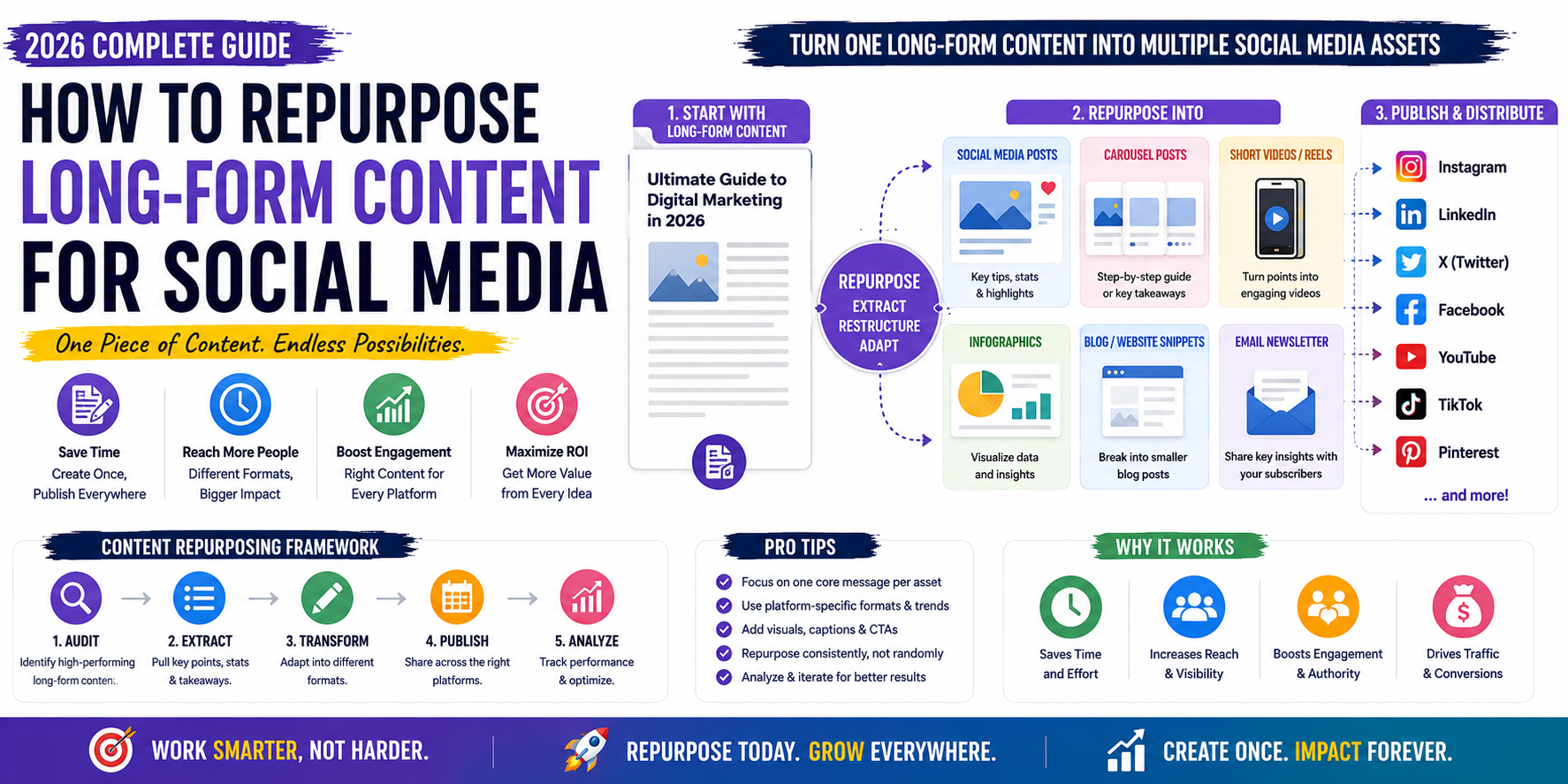
By strategically breaking down long-form content into smaller, digestible social media assets, you can maximize your reach, reinforce your brand messaging, and drastically reduce the hours you spend brainstorming new ideas. In this comprehensive guide, we will explore exactly how to repurpose your long-form assets for massive social media growth.
What is Content Repurposing?
Content repurposing (also known as content recycling) is the practice of taking an existing piece of content, like a 2,000-word blog post, a 30-minute YouTube video, or an hour-long podcast and adapting it for different platforms and formats.
It is not simply copying and pasting a link to your article on Facebook. It is about natively reformatting the core message so that it fits the unique style and audience expectations of platforms like Instagram, LinkedIn, X (formerly Twitter), and TikTok.
Why You Must Adopt a Repurposing Strategy
If you are not repurposing your content in 2026, you are leaving massive amounts of digital real estate on the table. Here is why this strategy is non-negotiable for serious website operators and brand builders:
- Expands Your Reach: Different people prefer consuming content in different ways. Some love reading long articles, while others only watch 15-second Reels. Repurposing ensures you capture both audiences.
- Improves SEO and Brand Authority: When you consistently talk about the same core topics across multiple platforms, search engines and social algorithms start to recognize you as a topical authority in that specific niche.
- Saves Massive Amounts of Time: Writing one deep-dive article takes time. But pulling ten short quotes from that article takes minutes. You get a higher return on investment (ROI) for the initial time spent creating the “hero” content.
- Reinforces Your Message: Marketing psychology states that a user needs to see a message multiple times before taking action. Repurposing allows you to repeat your core message without sounding repetitive.
The “Hero Content” Framework
To build a sustainable repurposing engine, you need to understand the “Hero Content” model.
- Hero Content (The Pillar): This is your main, long-form piece of content. It is highly detailed, deeply researched, and usually takes the most time to create. Examples include a massive SEO guide on your blog, an ultimate tutorial on YouTube, or an insightful industry podcast interview.
- Micro-Content (The Splinters): These are the smaller pieces extracted from the Hero Content. These are your Instagram Carousels, YouTube Shorts, LinkedIn text posts, and X threads.
Instead of creating micro-content from scratch, you simply “splinter” your Hero Content. Let’s look at actionable ways to do this. Explore more and learn about How to Create a Social Media Content Calendar from Scratch.
4 Highly Effective Ways to Repurpose Long-Form Content
Here are the best strategies to turn one big idea into dozens of social media posts.
1. Turn Blog Posts into Instagram & LinkedIn Carousels
Long-form articles are packed with step-by-step guides, statistics, and subheadings. This structure is perfect for carousel posts (swipeable graphic posts).
- The Strategy: Take an article titled “5 Ways to Improve Website Speed.”
- The Execution: Create a 6-slide carousel. Slide 1 is the hook (the title). Slides 2 through 5 each feature one specific tip summarized from the blog post. Slide 6 is a Call to Action (CTA) telling users to “Read the full guide via the link in our bio.”
- Why It Works: Carousels are the most saved format on social media. They provide instant value and naturally drive traffic back to your main website.
2. Transform YouTube Videos into Short-Form Reels and TikToks
If you are producing horizontal, long-form video content, you are sitting on a goldmine for short-form platforms.
- The Strategy: Do not just upload the whole video. Find the “aha moments”—the 15 to 45-second clips where you deliver a punchline, reveal a surprising statistic, or explain a complex concept simply.
- The Execution: Use AI video clipping tools to automatically find and crop these highlights into a 9:16 vertical format. Add dynamic, native captions on screen, as most users watch short-form video on mute.
- Why It Works: Short-form video platforms have the highest organic reach of any medium right now. One viral Reel can drive thousands of subscribers back to your main YouTube channel.
3. Convert Long Articles into X (Twitter) Threads
X (formerly Twitter) thrives on text-based, sequential storytelling. Your detailed blog posts are ready-made scripts for viral threads.
- The Strategy: Strip out the fluff and focus purely on the core arguments and data points of your article.
- The Execution: The first post in the thread must be an undeniable hook. For example, “90% of beginners fail at technical SEO. Here is a 7-step checklist to ensure your site actually ranks.” Then, use each subsequent post in the thread to summarize a different section of your article. End the thread by linking the original blog post.
- Why It Works: Threads dominate the X algorithm, keeping users on the platform longer while establishing your thought leadership.
4. Extract Quotes for High-Engagement Graphics
Sometimes, the simplest content performs the best. A strong, opinionated sentence from an article or a podcast can stand on its own as a powerful social media asset.
- The Strategy: Read through your latest blog post or listen to your latest podcast and highlight one sentence that is controversial, highly motivational, or thought-provoking.
- The Execution: Design a clean, branded graphic template in Canva. Paste the quote in a large, readable font. In the post caption, expand on the context behind the quote and ask your audience for their opinion.
- Why It Works: Quote graphics are highly shareable. People love reposting quotes that align with their personal beliefs to their own Stories, instantly expanding your brand’s visibility.
Essential Tools for Content Repurposing
You don’t need a massive team to execute this strategy. Leverage these digital tools to automate the heavy lifting:
- Canva: The ultimate design tool for turning blog post text into beautiful, branded carousel graphics and quote templates.
- Opus Clip or Vidyo.ai: Artificial intelligence tools that scan your long-form YouTube videos and automatically generate vertical Shorts/Reels complete with captions and jump cuts.
- Buffer or Metricool: Social media management dashboards that allow you to take your newly repurposed assets and schedule them across all your platforms in one sitting.
Final Thoughts on Working Smarter, Not Harder
Creating content for a digital business should not feel like an endless grind. By implementing a strong repurposing strategy, you shift your focus from constant creation to strategic distribution.
The next time you write an in-depth article for your WordPress site, don’t just hit publish and move on. Look at that article as a tree. From that one trunk, you can grow branches of Reels, Carousels, Threads, and Quotes. Repurpose relentlessly, maximize your visibility, and watch your organic traffic scale sustainably.

