
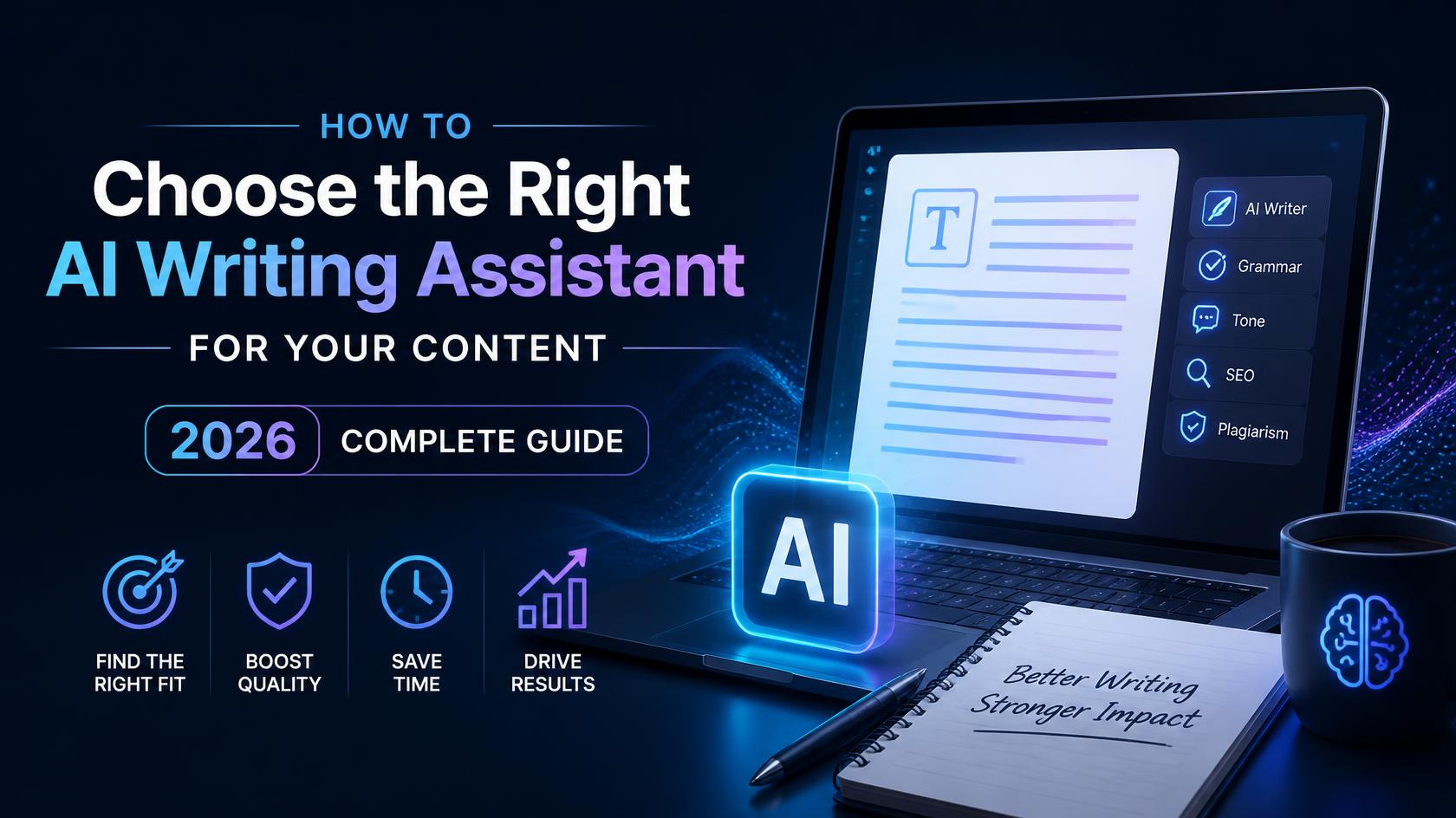
The digital content landscape has undergone a massive paradigm shift. Just a few years ago, producing a 2,000-word SEO-optimized blog post or drafting a month’s worth of social media captions required hours of intense, uninterrupted focus. Today, artificial intelligence has completely rewritten the rules of content creation.
In 2026, AI writing assistants are no longer experimental novelties; they are mandatory tools for digital survival. Whether you are a freelance web developer writing technical documentation, an SEO specialist scaling niche websites, or a creator managing multiple social platforms, leveraging AI is the only way to remain competitive.
However, the market is completely flooded. From ChatGPT and Claude to Jasper and Copy.ai, there are hundreds of tools promising to do your work for you. Choosing the wrong tool can lead to generic, robotic content that hurts your brand’s reputation and gets penalized by search engines.
In this comprehensive guide, we will break down exactly how to evaluate, select, and utilize the right AI writing assistant for your specific digital workspace needs.
The Misconception About AI Writing Tools
Before we look at the features, we need to address the biggest misconception regarding AI in content creation: AI is an assistant, not an autopilot.
If your strategy is to generate a prompt, click a button, and immediately copy-paste the output directly onto your WordPress site, you will fail. Search engines, specifically Google, have sophisticated algorithms designed to reward E-E-A-T (Experience, Expertise, Authoritativeness, and Trustworthiness). Purely AI-generated content lacks human experience.
The goal of choosing an AI writing assistant is to eliminate the “blank page syndrome.” It should help you brainstorm outlines, generate first drafts, and write meta descriptions, freeing you up to spend your time editing, adding personal anecdotes, and fact-checking. When you use AI to handle the heavy lifting, you can easily [Anchor Text: automate repetitive tasks in your daily workflow -> Link to: automate-repetitive-tasks-workflow], allowing you to focus on strategy and growth.
Core Features to Look for in an AI Writing Assistant
Not all AI tools are created equal. When evaluating a platform, do not just look at the price tag. You need to look at the underlying technology and feature set. Here are the four critical features to evaluate:
1. Brand Voice Customization
The biggest complaint about AI writing is that it sounds like a robot. It uses overly complex words like “delve,” “tapestry,” and “testament.” The best AI writing assistants allow you to train the model on your specific brand voice. You should be able to upload previous articles you have written so the AI can analyze your tone, sentence structure, and vocabulary, ensuring the generated content sounds like you.
2. Native SEO Integrations
If you are writing for a blog, your primary goal is likely ranking on Google. Standard chatbots do not know which keywords are currently trending or what the search intent is for a specific query. Look for writing assistants that integrate directly with SEO tools (like SurferSEO or SEMrush). These tools analyze top-ranking competitor pages and guide the AI to include the exact semantic keywords required to rank.
3. Long-Form vs. Short-Form Capabilities
You need to define your primary use case.
- Are you primarily building a social media content calendar and writing short, punchy Instagram captions?
- Or are you writing 3,000-word definitive guides on technical web operations?
Some models (like Claude) excel at maintaining context over thousands of words, making them perfect for bloggers. Other tools are specifically trained on direct-response copywriting frameworks, making them better for social media and email marketing.
4. Plagiarism and AI Detection Checks
While Google does not penalize AI content inherently (as long as it is helpful), it absolutely penalizes plagiarism. Furthermore, if you are a freelance writer producing work for clients, turning in raw AI content can breach contracts. A premium writing assistant should have built-in plagiarism checkers (like Copyscape) to ensure every sentence is 100% original.
Top AI Writing Assistants for Digital Creators in 2026
To help you cut through the noise, here is a breakdown of the top-tier AI writing assistants currently dominating the market, categorized by their best use cases.
1. ChatGPT (Plus Version) – Best for General Purpose Versatility
OpenAI’s ChatGPT remains the industry standard. While the free version is decent, the “Plus” subscription gives you access to the latest models and custom GPTs.
- Why it works: It is incredibly versatile. You can feed it a massive PDF and ask it to summarize the data, or you can ask it to write Python scripts for your web development projects.
- The Drawback: It tends to have a very recognizable “AI tone.” You will need to spend significant time writing highly detailed prompts to get a natural-sounding output.
2. Claude (by Anthropic) – Best for Long-Form Bloggers
If your primary focus is writing long-form, highly nuanced blog posts, Claude is arguably superior to ChatGPT.
- Why it works: Claude has a massive “context window,” meaning it can remember and analyze huge amounts of text at once without losing the plot. More importantly, its natural writing style is much more conversational, human-like, and less prone to using robotic buzzwords.
3. Jasper AI – Best for Marketing Teams and Agencies
Jasper was built specifically for marketers. It does not try to be a general chatbot; it is a dedicated marketing machine.
- Why it works: Jasper comes loaded with hundreds of templates for Facebook ads, Google Ads, AIDA (Attention, Interest, Desire, Action) copywriting frameworks, and email sequences. It also features incredible brand voice training.
- The Drawback: It is significantly more expensive than standard chatbots, making it better suited for agencies with a dedicated software budget.
How to Integrate AI into Your Content Workflow
Once you have chosen your tool, you need a standardized operating procedure (SOP) to use it effectively. Here is a foolproof workflow to ensure high-quality output:
- The Ideation Phase: Ask your AI to generate 10 content ideas based on a specific keyword.
- The Outline Phase: Once you pick an idea, command the AI to create a comprehensive
H2andH3outline. Review this outline manually and inject your own unique talking points. - The Drafting Phase: Have the AI write the content section by section (not all at once). This keeps the AI focused and prevents it from rambling.
- The Repurposing Phase: This is where AI truly shines. Once your long-form article is finished, feed it back into the AI and ask it to [Anchor Text: repurpose the long-form content for social media -> Link to:
repurpose-content-for-social-media]. Have it extract three Twitter threads and five LinkedIn posts from your original text. - The Human Edit (Crucial): Never skip this step. Read the entire document out loud. Remove robotic phrases, add your personal experiences, and insert internal links to your other website pages.
Final Thoughts
Choosing the right AI writing assistant is like choosing a business partner. You need a tool that complements your weaknesses and scales your strengths. Whether you opt for the conversational brilliance of Claude, the marketing powerhouse of Jasper, or the versatility of ChatGPT, the key is execution. Treat the AI as a junior writer who needs your expert guidance, and you will multiply your content output without ever sacrificing quality.

